Most buying decisions happen when you're not around.
As we covered in Part 1 of this series, performance data only tells you how the content you already have is doing. It can't tell you whether you're even in the room where the decision gets made — and most of the time, you aren't.
When planning a campaign, you naturally plan for the moments you can control, like the demo, the webinar, or the email open. Those moments feel like they're the main event.
But the data says they are only a supporting act. Most research and decisions happen when your team isn't around, and most of what fills that space is content.
Why You Can't Afford to Miss on Content Coverage
Gartner finds that B2B buyers spend only about 17% of their buying journey with all their potential vendors combined, and just 5–6% with any single sales rep.
That means for roughly four-fifths of the process, the buyer isn't talking to you (or any other sellers for that matter).
With such a little window of opportunity for face time, you can't afford to miss on content coverage, making it imperative to provide ample opportunity for self-led discovery.
The majority of problem/solution/vendor research is happening on a person's own time, that you're not part of and can't control, like a late-night Claude session, a Slack thread between a buyer and their boss, or a comparison on a peer review site.
Whatever shapes the buyer's opinion is doing the real work, and most of it is content.
If You Don't Fill the Content Gaps, Your Competitors Will
What are buyers doing during the other 83% of their buying journey?
In all that time away from your team, they aren't idle. They're self-educating, comparing options, ruling out vendors, and building internal consensus about what to buy. They're forming the opinion your sales rep will later either confirm or fight uphill against.
And they do it with whatever content exists.
If your marketing team has published content with a clear, credible point of view for the buyer's segment and role, that undoubtedly shapes the buying team's consensus. But if not, they don't wait for you to create it. They build their understanding out of someone else's material, usually a competitor's, or a generic version that doesn't fit their situation.
The decision takes shape either way. The only question is whether your perspective was amongst your competitor's when it happened.
Content Performance vs. Content Coverage
Here is where this connects back to content performance.
Your performance data measures the engagement you can see, like the opens, clicks, and conversions in the moments a buyer interacts with you directly. Whereas content coverage measures the gaps in your content against your revenue plan relative to baselines and scores your coverage according to defined segments, personas, and funnel stages.
To cover all your bases and stay front and center during 100% of the buying journey, you must first build content that supports pipeline creation by filling the gaps. And to do that, you need to know where your gaps are relative to your revenue plan and your top competitors.
A segment without content coverage during the long buying journey looks completely fine on a performance dashboard. The metrics for the content you do have might even be strong, but performance simply can't tell you whether the segment has coverage or not.
That's the boundary of what response-based measurement can ever see, and why performance metrics are necessary but not sufficient for building an informed revenue strategy.
Why Performance and Content Coverage Go Hand in Hand
Both measurements, together, give you the full spectrum of content intelligence.
Performance measures the efficacy of your content after you've filled the gaps. Content coverage is a measure of presence, whether you are there, with a credible point of view, across the stages where buyers decide, and especially the stretch where no sales person is present at all.
Seen that way, content stops being strictly a support act for sales conversations and becomes your representation in the largest part of the buying process.
A marketing leader who tracks only performance optimizes what already exists, but one who also tracks content coverage can know their share of authority in the market, then prioritize filling the segment, persona, and funnel-stage gaps that matter most to the revenue plan instead of guessing or trying to publish everywhere all at once.
Shifting your thought process from only measuring response to also measuring presence will start to change how you talk about revenue with other members of the leadership team. And that's what we discuss in part three of our blog series.
Frequently Asked Questions
Why does coverage matter if a segment already performs well?
Coverage matters because it can help you understand your share of authority in the market, while performance data can't. Share of authority measures how much credible, expert mind-share your brand commands in your industry compared to competitors. If you don't have content for half your target segments, but your competitor does, you can use that knowledge to shape your strategy and decisions moving forward.
While existing segment-based content might be performing well, that doesn't identify your gaps or whether you're light on certain topics. With VelocityEngine's Content Coverage Heatmap, you can get a clear picture of yours and your competitor's coverage, use the intelligence to align internally, then fill the gaps to increase your share of authority.
What are buyers doing during the other 83% of their buying journey?
They aren't idle. Buyers spend that time self-educating, comparing options, ruling out vendors, and building internal consensus about what to buy — forming the opinion a sales rep will later either confirm or fight uphill against. They do this with whatever content exists, whether or not it's yours. If your team hasn't published a clear point of view for their segment and role, buyers build their understanding from someone else's material instead, usually a competitor's.
Does producing more content improve content coverage?
Not on its own. More content helps only when it lands where the revenue strategy has risk exposure.
The measure of coverage is presence against the revenue plan, rather than the count of assets produced in and of itself.
Volume added to segments you already cover raises output without necessarily closing any gaps. However, there is a use case for that, which is maintaining a high share of authority. If you own the market in one category and it's your top selling point, staying on top probably matters to your bottom line.
Generally though, coverage improves when content appears where nothing is present yet, especially for the segments, personas, and stages your revenue plan depends on. Tools like the Content Coverage Heatmap now make this knowable, giving both marketing and sales a shared, living heatmap of where coverage exists and doesn't, so teams can act on evidence, not intuition.
How does the Content Coverage Heatmap work?
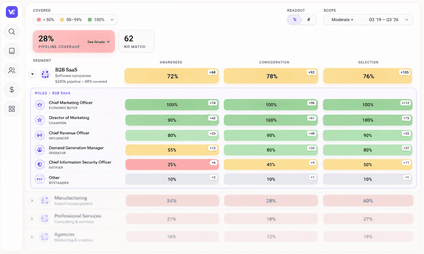
It scores your coverage green where you are covered and red where you are exposed, by segment, persona, and funnel stage. Each cell can be opened to see the existing assets tied to it, understand what is missing, and move from gap identification to suggested next action.
Run the Content Coverage Heatmap to see exactly where your content provides coverage for your revenue plan, and where it doesn't.
In practice, the heatmap starts from revenue-plan inputs such as target, coverage, conversion, and allocation by segment, then uses confirmed segments and personas to make the coverage gap visible at the cell level. You can drill into each cell to see the existing assets behind the score, review suggestions for how to close the gap, and use one-click build from any identified gap to accelerate creation of missing content. As content ships, coverage updates automatically, so the map stays current for both marketing and sales. You can also scan a competitor site or PE acquisition target to benchmark coverage against market and portfolio priorities.